

Instructor Ratings · Part 61
CFI And CFII Training
Initial CFI and the CFII, trained in our Cessna 172S — taught by instructors who do this job daily at a two-person school, which is a different education from a course designed to move you through in a fortnight.

What It Costs
$5,500–$8,000initial CFI, typical budget
The school's own planning range. The CFII typically runs $3,500–$6,000, and the MEI $4,500–$7,500 in the Piper Seminole. All three exclude the examiner’s fee. These are ranges, not package prices — the ground hours vary enormously, because the initial CFI is mostly a teaching qualification and how long it takes depends on how comfortable you are explaining things out loud.
- $3,500–$6,000
- CFII, typical budget
- $4,500–$7,500
- MEI, typical budget
What You Need First
- CFI (initial)
- Prerequisite
- A commercial certificate and an instrument rating.
- CFII
- Prerequisite
- A current CFI and an instrument rating.
- Spin endorsement
- Flown elsewhere
- The initial CFI requires spin training and an endorsement, which is done in an aircraft approved for spins. Ask us and we will name the provider we send candidates to; bring the endorsement back and we carry on from there.
- MEI
- Flown here
- The multi-engine instructor rating is flown in the school’s Piper PA-44 Seminole, so you do not change schools to add it. A commercial certificate and a multi-engine rating come first.
A Teaching Qualification, Assessed In An Aircraft
It is not a flying course with a teaching component bolted on.
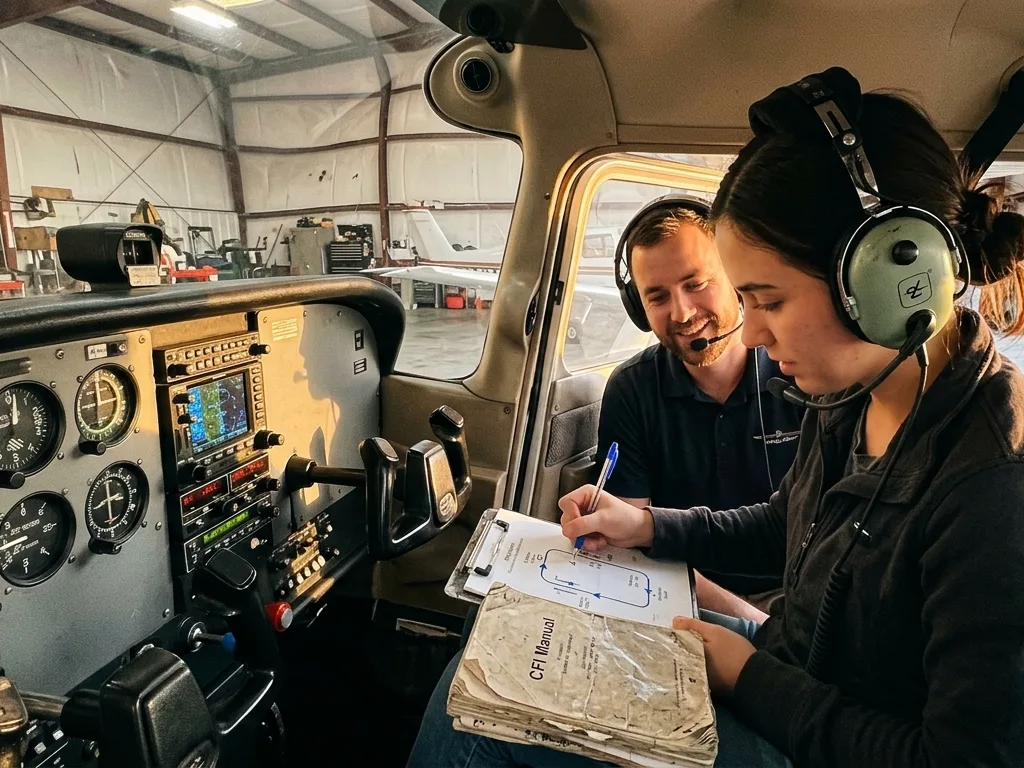
- Far more hours at a table than in the air — 40 hours of ground against 10 of flight.
- The checkride is famously long, mostly oral, and mostly about explaining a subject to somebody who does not know it yet.
- The fundamentals of instruction catch people out.
- So does teaching from the right seat.
- So does talking continuously while flying accurately. We drill all three.
A CFI is a working qualification, and we will talk you through what instructing is really like before you commit — the hours, the pay, the weather, and what teaching does for your own flying. We are glad to talk about instructing here when capacity comes up.
The parts of an instructor rating people are least warned about.
Why Most People Take The CFI
Almost nobody adds an instructor rating because they wanted another certificate. They add it because it is the one job in aviation that pays you to log the hours you still need. A commercial certificate can be finished at around 250 hours; an airline transport pilot certificate asks for 1,500, with lower figures — 1,250, 1,000 and 750 — for particular associate degree, aviation degree and military routes. Instructing is how most people cross that gap without buying the aircraft time out of their own pocket.
It is paid by the flight hour rather than as a salary. Here that is $35 an hour of flight instruction, so what you earn follows what you actually fly: the weather, the daylight, and how many students a school has on its books. That is worth knowing before you commit the ground hours, and worth setting against the hours themselves — a hundred hours instructed is a hundred hours you were paid for instead of a hundred you bought at $120. The other half of the return is harder to price — teaching a manoeuvre to somebody who has never flown it makes you better at flying it than any amount of practising alone.
14 CFR Part 61 on eCFRWhy the Ground Hours Are the Bigger Number
The initial CFI is not a flying course with a teaching component bolted on. It is a teaching qualification that happens to be assessed in an aircraft. You will spend far more hours at a table than in the air — that is why the estimate is 40 hours of ground against 10 of flight — and the checkride is famously long, mostly oral, and mostly about whether you can explain a subject to somebody who does not know it yet.
The parts that catch people out are the fundamentals of instruction, teaching from the right seat, and being able to talk continuously while flying accurately. We drill all three.
The Written Exams Come First
Before the checkride there are written exams, and the initial CFI has two of them. They are booked, paid for and sat by you at an FAA-approved testing centre rather than arranged by us, and they are the part candidates most often leave until the ground work is already finished. Sit them early: a result in hand is what lets the ground sessions be about teaching rather than about revision.
- Fundamentals of Instructing, with narrow exemptions in Part 61 for people who already hold a teaching credential.
- Flight Instructor Airplane, the subject-matter exam for the initial rating.
- Flight Instructor Instrument, added when you go on to the CFII.
- Part 61 also asks that you be at least 18 and able to read, speak and understand English.
Spin Training Is Flown Elsewhere
The initial CFI calls for spin training and a spin endorsement, flown in an aircraft approved for spins. Ask us early and we will name the provider we send candidates to, so you can book it alongside your ground work rather than at the end.
Bring the endorsement back and it slots straight into your training here — it is a normal part of the plan, and we build your schedule around it.
How Long It Takes, And What Sets The Pace
There is no honest single number, and the academies advertising a fortnight are answering a different question — they are quoting the length of a residential course, not the length of your preparation. The flying is the small part: the plan here is 10 hours in the air against 25 on the ground.
What sets your calendar is the three things sitting outside those hours — passing the written exams, booking the spin endorsement with the provider we name, and getting comfortable enough to teach a subject out loud rather than recite it. Flying runs seven days a week, 7am to 7pm, so the schedule is rarely the constraint. Tell us what you already hold and when you last flew, and we will put dates against it instead of a slogan.
Tell us what you already holdInstructing After The Rating
We are always glad to talk through instructing here when capacity comes up.
Either way we will be straightforward with you about what instructing is really like — the hours, the money, the weather, and what teaching does for your own flying.
Commercial pilot trainingKeeping The Certificate, And The Two That Follow
A flight instructor certificate is not something you hold for life. It runs for 24 calendar months and then has to be renewed — through a flight instructor refresher course, through a record of activity and checkride pass rate, or through a reinstatement check. Almost nobody is warned about that until the first expiry is close.
The two ratings that follow both widen what you are allowed to teach. The CFII lets you take instrument students, which is the difference between teaching when the weather is good and teaching most of the year. The MEI is flown here in the school’s Piper PA-44 Seminole, so adding it does not mean changing schools.
Multi-engine and the MEIWhat the Estimates Assume
Both figures exclude the examiner’s fee. They are planning estimates rather than guaranteed package prices, and the ground hours in particular vary enormously: how long the initial CFI takes depends on how comfortable you are explaining things out loud. Prices last updated August 13, 2026.
The full rate cardWho Teaches It
Denis Vyatkin, who owns the school and oversees the instructor certificates, and Sergio, who teaches most primary students.
Meet the instructorsWhat is CFI training?
It is the training for a flight instructor certificate — the qualification that lets you teach flying and be paid for it. In practice it is a teaching course assessed in an aeroplane: the plan here is 40 hours of ground against 10 of flight, and the checkride is long and mostly oral.
Is a CFI a license or a certificate?
A certificate. The FAA issues a flight instructor certificate with ratings on it — airplane single-engine, instrument, multi-engine — and it sits alongside your pilot certificate rather than replacing it. It also expires: it runs for 24 calendar months and has to be renewed, which a pilot certificate does not.
How much do CFIs get paid?
Instructing is paid by the flight hour rather than as a salary, so earnings follow how much you actually fly — the weather, the daylight, and how many students a school has. Ours is $35 an hour of flight instruction; rates differ from school to school around Sacramento. Most people treat the pay as secondary to the hours: instructing is the cheapest way to get from a commercial certificate to the 1,500 hours an airline transport pilot certificate asks for.
How long does it take to become a certified flight instructor?
It depends on the ground work, not the flying — the flight portion is estimated at 10 hours. Around it sit the written exams you book yourself, a spin endorsement flown at another provider, and however long it takes to become comfortable teaching out loud. We do not run a two-week residential course, and we will put dates against your own situation before you commit to anything.
How do I become a certified flight instructor?
You need a commercial certificate and an instrument rating, to be at least 18, to read, speak and understand English, to pass the written exams, to hold a spin training endorsement, and then to pass a checkride that is mostly oral. The full eligibility list is in 14 CFR Part 61 rather than in any school’s brochure.
How much does CFI training cost?
The planning range here is $5,500–$8,000 for the initial CFI, $3,500–$6,000 for the CFII and $4,500–$7,500 for the MEI in the Piper Seminole. All three exclude the examiner’s fee, and neither the spin endorsement, which is flown at another provider, nor the FAA written exam fees, which you book yourself, sit inside those ranges.
From The Flight Line
The school as it flies — straight from its Instagram.
Tell Us Where You Are
Ask About Instructor Training
Tell us what you hold and when you last flew, and we will map out what is left, what it would cost, and where you will need to go elsewhere.