

Instrument Rating · Part 61
Instrument Rating Training
Trained in our IFR-equipped Cessna 172N, with a private pilot certificate as the starting point. The whole rating is flown in the aircraft — real approaches in real Sacramento Valley airspace, with real ATC and real weather.

What It Costs
$110an hour of flight education, all in
The same rate as every other programme here, on the ground and in the air, with the instructor already in it. The total depends on how much cross-country PIC time you already hold and how consistently you can fly, so we build the estimate from your logbook — the range below is the school's own planning figure, not a package price.
- $8,000–$12,000
- typical total budget
- ~$175
- knowledge test, paid to the centre
Flying On A Clearance, By Reference To The Instruments
An instrument rating lets you fly in cloud and in weather that would keep a VFR-only pilot on the ground.
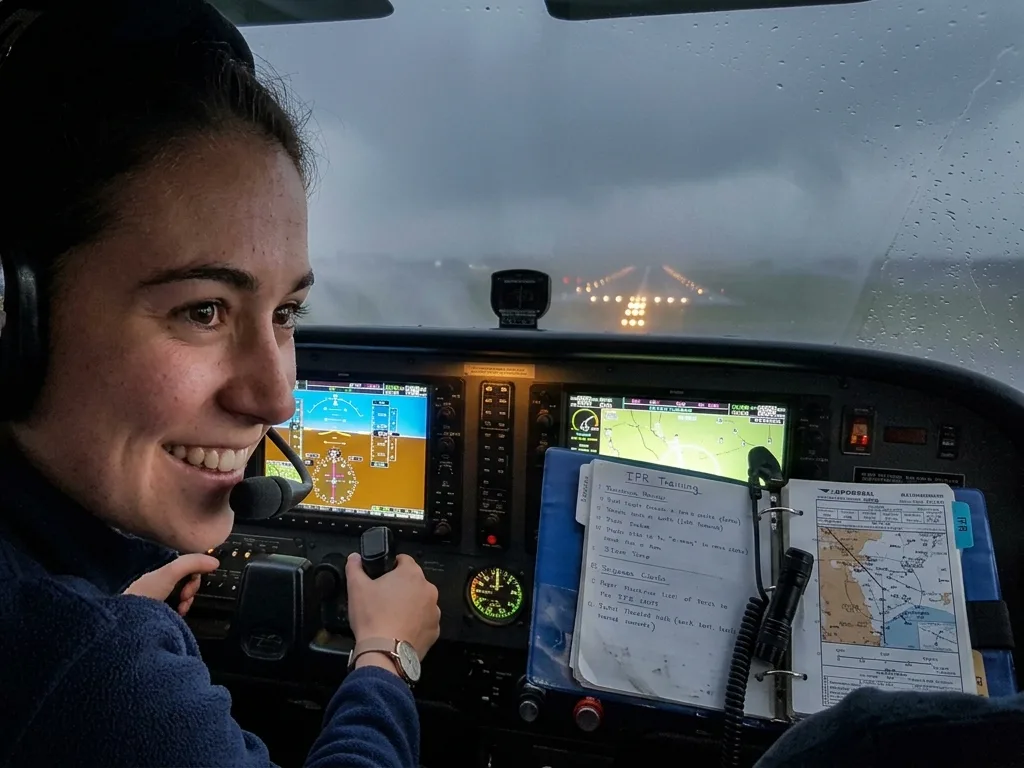
- Two kinds of people come to us for it: pilots who want their flying to be useful rather than fair-weather, and pilots building toward a commercial certificate.
- For the commercial, the instrument rating is effectively a prerequisite in practice.
- Most instructors will tell you it is the rating that makes you a genuinely better pilot.
- The precision it demands does not go away when you go back to flying in clear air.
Before you start you need a private pilot certificate, a current medical certificate or the relevant basic eligibility, and cross-country time as pilot in command — which you may already hold, or may build during training.
The aircraft, the scheduling, and what the rating asks of you.
The Aircraft
Our Cessna 172N is IFR-equipped and is where most of the rating is flown; the Cessna 172S adds the Garmin G1000 glass panel for the advanced-avionics work. Neither has an autopilot, so you hand-fly every approach.
Hand-flying the whole rating is harder work than flying it coupled. It also means you finish it able to fly an approach when the automation is not available, which is the situation the rating exists for.
The Cessna 172S in detailEvery Hour Is Flown In The Aircraft
Some schools fly part of the rating in an approved simulator, which is cheaper per hour and lets you repeat an approach ten times in a row. Here the whole rating is flown in the aeroplane, at $110 an hour, all in.
What you get for that is the real thing from the first lesson: Sacramento Valley airspace, live ATC, actual weather, and the workload of flying an approach while the radio is busy. It is the situation the rating exists for, and finishing in it is what makes the rating usable the week after your checkride.
What The Rating Actually Requires
The rating is defined in hours, and the one that catches people out is not the instrument time. It is the cross-country. None of these are our rules and none of them are ours to move — they are set out in 14 CFR 61.65, linked below.
- 50 hours of cross-country flight time as pilot in command, at least 10 of them in an aeroplane. Most private pilots arrive holding part of this and finish it while they train.
- 40 hours of actual or simulated instrument time. Hood time you logged during your private certificate counts toward it.
- 15 of those 40 flown with an instrument instructor, and 3 of them within the two calendar months before the checkride.
- One IFR cross-country of at least 250 nautical miles, flown on airways or an ATC routing, with an instrument approach at each of three different airports and three different kinds of approach.
- The knowledge test before the checkride, and a current medical certificate or the relevant basic eligibility.
If The Cross-Country Hours Are Not There Yet
Most private pilots reach this point short of the 50 hours, and it is the commonest reason somebody decides they are not ready. They usually are.
The order is flexible. The cross-country time can be built during the rating rather than before it, and flying those trips as instrument cross-countries — on a clearance, with an approach at the far end — means the same hour counts twice instead of once. That is the difference between building the time and burning it, and it is the single largest variable in what the rating ends up costing you.
Tell us what the logbook says and we will work out which hours you still need before you commit to anything.
How Hard It Actually Is
It is the hardest rating most pilots do, and it is hard in a way that surprises people. Nothing about flying the aeroplane is new. What is new is doing four things at once while the aeroplane has stopped telling you which way is up.
- The scan. Reading the instruments in a rotating cross-check is a habit rather than a piece of knowledge, and habits decay between repetitions. This is the whole reason instrument training punishes gaps harder than any other rating.
- Division of attention. Flying, working the radio, briefing the approach and copying a re-clearance are each easy on their own. The rating is all four arriving together, and almost everybody meets a wall somewhere in the middle of training where they can no longer keep up with it.
- Holds and course reversals. The procedure students most often name as the one that broke them, usually because it gets taught as geometry when it is really a picture you either have yet or do not.
- Precision. The FAA’s Airman Certification Standards for this rating ask for roughly a hundred feet of altitude, ten degrees of heading and ten knots of airspeed — held while you do everything above. The private certificate is not flown to that.
- Partial panel. Flying the approach with an instrument failed, which is unpleasant the first several times and then stops being unpleasant.
Where People Get Stuck, And What Moves Them
The wall in the middle is a workload problem, not a talent problem. It moves when the parts underneath become automatic, and the only thing that makes them automatic is repetition close enough together to stack.
We are not going to quote you a pass rate we cannot show you. What is worth saying plainly is that the failure mode of this rating is rarely inability. It is the calendar: two months go by, the scan goes with them, and restarting from a cold scan costs hours nobody budgeted for. The difficulty of the instrument rating is mostly a scheduling problem wearing a flying problem’s clothes.
Which is why the scheduling below is not administrative detail. Two lessons a week is the single change that makes this rating cheaper and easier at the same time, and it is the one thing you control completely.
Harder Than The Private Certificate?
Yes and no, and the halves are worth separating, because people asking usually fear the wrong one.
- Harder: the study. The instrument knowledge test goes into regulations, charts, approach plates, weather and systems at a depth the private test never reaches, and there is no flying your way past it.
- Harder: the tolerance. Everything is flown tighter, and it is flown tighter while you are busier than you have ever been in an aeroplane.
- Easier: the fear. The private certificate asks somebody who has never flown to go up alone. Nothing here is unfamiliar in the way a first solo is unfamiliar — you are a pilot already, and this is a pilot learning a procedure.
How We Schedule It
Instrument training rewards frequency more than any other rating. Two lessons a week keeps the scan alive; one lesson a fortnight means rebuilding it every time. We fly seven days a week from 7 AM to 7 PM, which makes an early-morning slot before work a realistic pattern.
Once you are training with us you book your own slots in Flight Schedule Pro, or agree a standing weekly slot with your instructor.
Finding us at McClellanTwo Weeks, Or Several Months
The honest arithmetic on calendar time is that it follows frequency rather than the reverse. Forty hours of instrument time flown twice a week is a matter of months. Flown once a fortnight it is not twice as long — it is longer than that, because every lesson opens by rebuilding the scan the last one built.
Search for this rating and you will find fourteen-day courses. They are real and they work, and it is worth being clear about what the choice actually is.
- An accelerated course compresses the rating into a fortnight of full days. It suits a pilot who already holds the 50 hours of cross-country, can take two clear weeks off work, and wants it done. You fly somebody else’s weather in somebody else’s airspace, and you pay for somewhere to sleep while you do it.
- Training here is flown around a job. Two lessons a week is the pattern, and the flying happens in the airspace and the weather you will actually use the rating in, from the first lesson.
- Nothing here is prepaid and nothing expires. If a month goes badly you pause it, and the only cost is the rust.
Who Teaches It
Denis Vyatkin oversees the instrument rating and the instructor certificates; Sergio teaches instrument and cross-country planning.
Meet the instructorsWhat Else You’ll Pay For
Additional costs are paid to other people: the knowledge test at about $175, the examiner’s fee for the checkride, and any course materials you choose.
The full rate cardWhat This Rating Costs Elsewhere
The question is asked often enough that Google answers it above the results: an instrument rating runs about $8,000 to $15,000 trained part-time and locally. The schools that publish a figure sit inside that — $12,255 at one, $13,500 at another built on $200 an hour for fifty hours of flying.
Our planning range is $8,000 to $12,000 at $110 an hour. The comparison worth making is the rate rather than the total, because the total depends on your logbook and the rate does not.
- $110 an hour here is the aeroplane and the instructor together, on the ground and in the air. Where a school quotes aircraft and instruction separately, add them up before you compare.
- A school that flies part of the rating in a simulator shows a lower hourly and makes a real saving. Here the whole rating is flown in the aeroplane, and the rate is still under what much of the market charges for the aircraft alone.
- The knowledge test is about $175, paid to the testing centre and not to us.
- The examiner sets their own fee for the checkride, so it is not ours to quote. Published figures for an instrument checkride run from roughly $600 to $1,500.
- If the rating is a step toward a commercial certificate rather than the destination, the hours you fly for it count toward that as well.
Do I need a private pilot certificate first?
Yes. You also need a current medical certificate or the relevant basic eligibility, and cross-country time as pilot in command — which you may already hold or may build during training.
Do you train part of the rating in a simulator?
No — every hour is flown in the aircraft, at $110 an hour, all in. You fly real approaches in real Sacramento Valley airspace, with live ATC and actual weather, which is the environment the rating is for.
What will the rating cost in total?
It depends on how much cross-country PIC time you already hold and how consistently you can fly, so the honest estimate comes from your logbook rather than from a package price. Tell us what is in it and we will work a realistic figure through with you on the phone.
How often should I fly?
Twice a week if you can. Instrument training rewards frequency more than any other rating: two lessons a week keeps the scan alive, one lesson a fortnight means rebuilding it every time.
How difficult is instrument training?
It is the hardest rating most pilots do, and the difficulty is division of attention rather than stick and rudder. Flying, the radio, the approach briefing and a re-clearance are easy one at a time and hard all at once, and almost everyone meets a wall in the middle of training where they cannot keep up with all four. It moves with repetition. That is why we push for two lessons a week: the instrument scan is a habit, and habits decay between flights.
Is the instrument rating harder than the private pilot certificate?
More work, less frightening. The study is harder — the knowledge test goes into regulations, charts, approach plates and weather at a depth the private test never reaches — and everything is flown to a tighter tolerance while you are busier. But nothing in it is unfamiliar the way a first solo is unfamiliar: you already know how to fly the aeroplane, and this is a pilot learning a procedure.
What does it take to get an instrument rating?
A private pilot certificate, 50 hours of cross-country flight time as pilot in command with at least 10 of them in an aeroplane, 40 hours of actual or simulated instrument time with 15 of those flown with an instructor, one IFR cross-country of at least 250 nautical miles, the knowledge test and the checkride. Those hours are set in 14 CFR 61.65 rather than by us, and the cross-country total is the one most private pilots are short of at the start.
How long does it take to get instrument rated?
It follows how often you fly rather than the calendar. Two lessons a week works through the required instrument time in a matter of months; one lesson a fortnight takes more than twice as long, because each lesson begins by rebuilding the scan. Fourteen-day accelerated courses exist and do work, but they need two clear weeks of full availability and the 50 hours of cross-country already in your logbook.
From The Flight Line
The school as it flies — straight from its Instagram.
Tell Us What’s In Your Logbook
Ask About The Instrument Rating
Total time, cross-country PIC, when you last flew — tell us and we will tell you what the rating would realistically take.